 Civil Resilience
Staying in touch
A radio, a power bank and numbers on paper, what a landline does in a power cut, and how to reach people or 999 when the mobile network is down.
- At home
Be Ready says phone and broadband disruption is usually short or local, but after severe weather it can last a number of days. An outage might affect some networks or all of them, and in the most serious case the mobile, the landline and the broadband are all down at once. A power cut takes out the home internet and possibly the mobile signal as well.
A radio
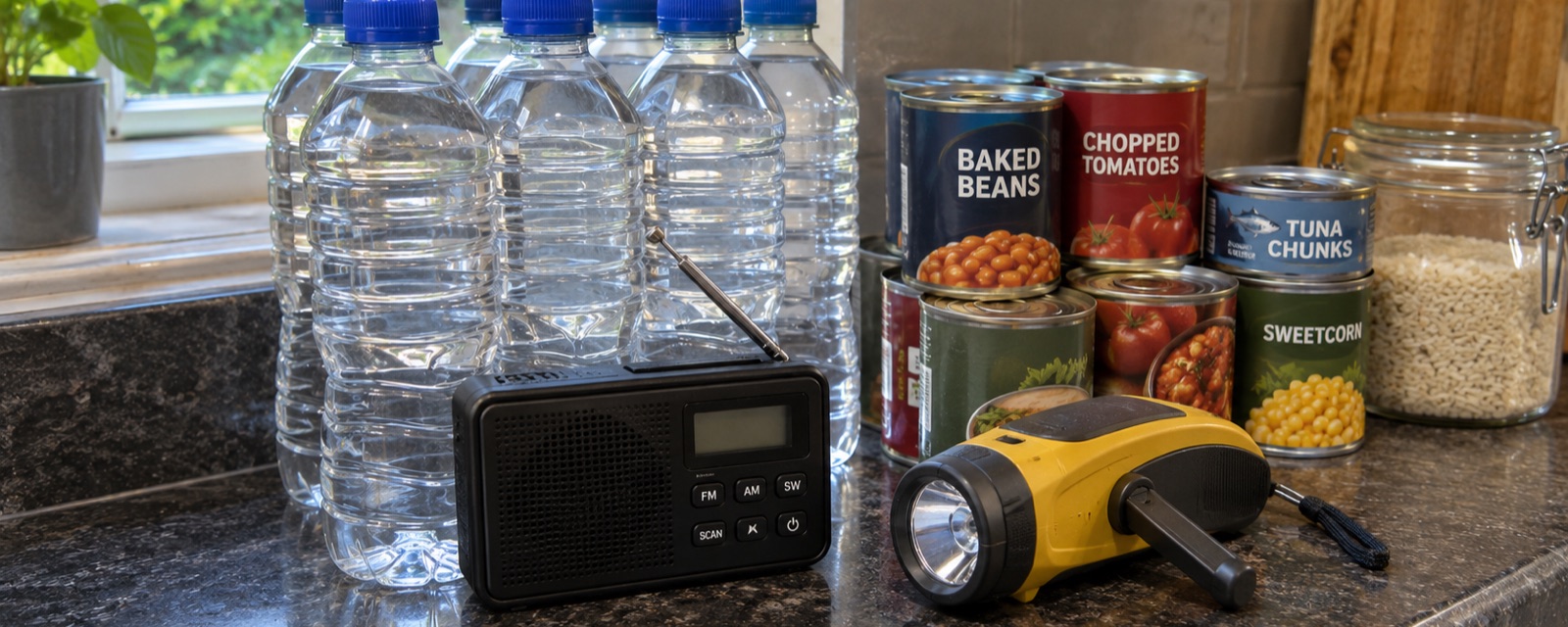
Keep a battery or wind-up FM radio at home with spare batteries. Updates may be given on the radio during an outage. Write down on paper the frequencies of the national or local stations you use for news, and keep that note with the radio and the torch somewhere easy to find in the dark. When searching for stations that are still broadcasting, try both FM and digital.
Numbers on paper
Keep a paper copy of important phone numbers (family, neighbours, doctor, utilities) and any other essential information, in case the phone loses power or you cannot get at your contacts. Include 105, the number to report a power cut in England, Scotland and Wales. Add emergency contacts or medical information to the phone's ICE or Medical ID feature, so the emergency services can read it without the passcode.
Landlines and telecare
The analogue landline network is being replaced by a digital one, and Be Ready says the old network is increasingly unreliable. If your only way of calling 999 is a landline, or you have a telecare kit connected to it, ask your provider whether it will work in a power cut. If you are a vulnerable customer, for example a telecare user, the provider must give you a free back-up battery unit that keeps the landline working for at least an hour, and many last longer. Details are at https://digitalphoneswitchover.com/. Ask your provider to record you as needing additional support; that can bring priority fault repair and tailored communications. If you rely on a personal alarm or a connected health device such as a diabetes sensor, ask the manufacturer how it behaves when the network is down.
When the mobile network is down
Be Ready's advice during an outage:
- If the landline is not working, try the mobile, and the other way round. A corded landline may still work in a power cut.
- If the mobile network is down but the Wi-Fi is up, Wi-Fi Calling on the handset may still make calls.
- If you cannot reach 999, try from both a mobile and a landline. Emergency calls from a mobile connect to any available network. If you still cannot get through and it is safe to do so, go to the nearest police station, fire station, ambulance station or hospital.
- Relay UK, Emergency SMS and 999 BSL remain the routes for people with communication needs, but a widespread outage may affect them too.
- Messaging may work when calls do not. Public Wi-Fi in cafés, offices or transport hubs may be available. Moving a short distance can improve signal, and someone nearby may be on a different network.
Agree a plan in advance
Agree a meeting point with family in case you cannot contact each other: somewhere easy to find and open to the public, or a relative's home. Agree with anyone who lives alone that if there is an outage and you cannot reach them, you will go to their home, or ask a neighbour to. Download or print maps, and know at least one alternative route home. See the household emergency plan page.
Checklist
- A battery or wind-up FM radio, with spare batteries
- The frequencies of the national and local stations you use, written down
- A charged power bank
- Important phone numbers on paper, including family, neighbours, doctor and utilities
- 105 written down, to report a power cut
- Emergency contacts in the phone's ICE or Medical ID feature
- A meeting point agreed with family in case you cannot contact each other
- Ask your landline provider whether the phone works in a power cut
- Maps downloaded or printed
Related pages
Sources
Last updated 29 October 2026. Reviewed 29 October 2026