 Civil Resilience
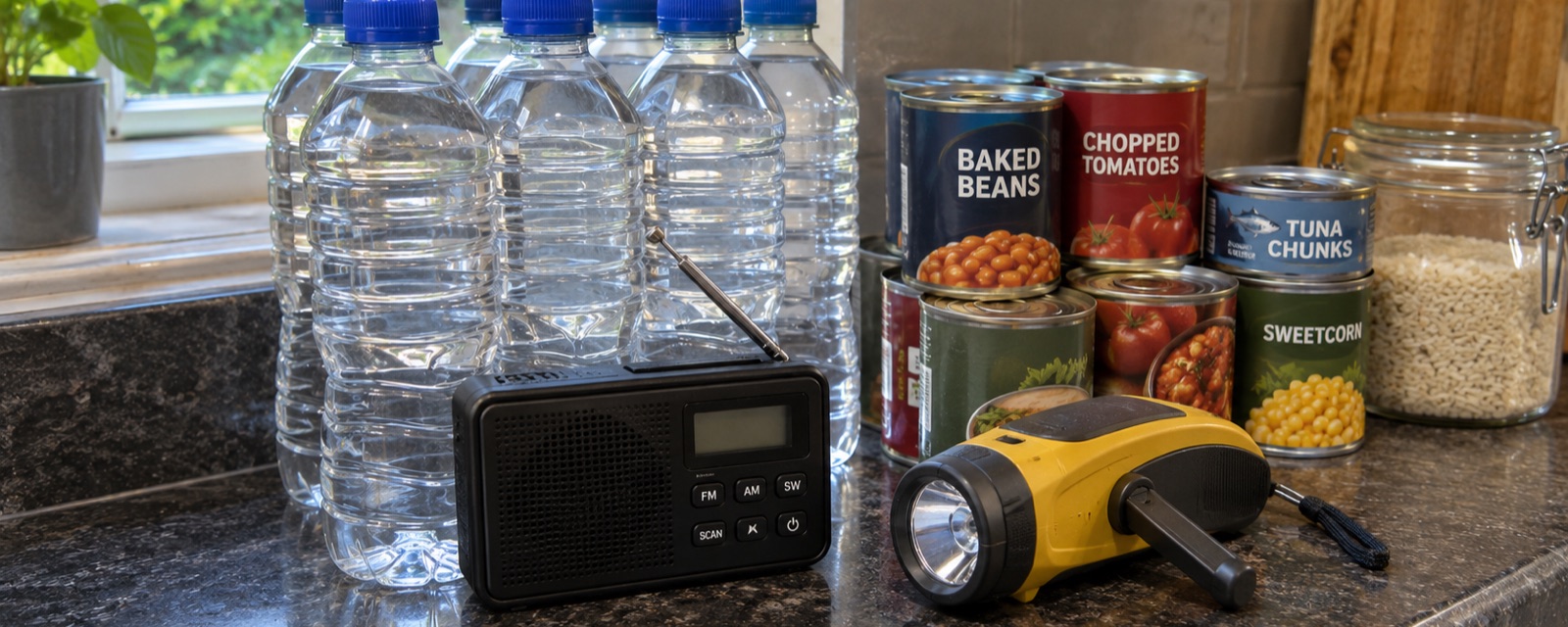
Three days at home
The government's Be Ready advice asks every household to be able to manage at home for three days, what that covers, and why three days rather than one.
- Plans
The Be Ready campaign at beready.campaign.gov.uk was developed by the Cabinet Office with local and national government, the responder community, voluntary organisations and academics. It asks every household in the UK to be able to manage at home for three days if everyday services are disrupted. The advice is the same whatever the cause: a storm, a flood, a power cut, a water outage or a loss of phone and broadband.
What the advice asks
Be Ready puts the reason in one sentence: being ready for three days helps you manage while support reaches those most in need. It is not a request to stockpile. The official checklist runs to nine categories: water, food, hygiene, light and warmth, communication and information, money and documents, medical and health, baby products and pet products. Be Ready says many homes already have some of the items.
The British Red Cross describes the same advice as three actions: prepare a home kit, make a household plan, and know where to get trusted information before and during an emergency.
Why three days
The Red Cross piece on the 72-hour advice says the first few days after an emergency are often the hardest, because a power cut, severe weather or transport disruption has knock-on effects that take time to resolve. A power cut alone can affect lighting, phone charging, internet access, card payments and, in some homes, water supplies or heating. Most people are more likely to meet a temporary disruption of this kind than a large-scale emergency.
Be Ready's power cuts page says the UK has a resilient electricity system and most power cuts are short and local, but wider and longer outages can happen and could last several days. Three days of readiness is pitched at that gap, while responders reach the people who need them first.
Where to start
Be Ready's own getting-started steps:
- See what you already have. Check the cupboards first.
- Plan for your household. Note what is still needed, including anything the family relies on such as medical supplies, baby formula or pet food.
- Build it gradually. Pick up missing items during regular shopping trips to spread the cost.
- Check it regularly. Set a reminder every six months to check expiry dates and swap items, or to update the kit if the household's needs have changed.
- Connect with your community. Talk to neighbours about what support you could share during an outage, and swap contact details.
Be Ready says not everyone will be able to take every action, and some people will follow only a few of the steps. The advice is to take the steps that work for you. Anyone with items to spare could consider donating them to people who cannot prepare their own household.
The pages in this section
Each part of the checklist has its own page here: water, food, power and light, keeping warm, staying in touch, cash and cards, medicines and health and documents and contacts. The household emergency plan page covers the decisions rather than the kit.
The official Be Ready checklist is a one-page PDF at https://beready.campaign.gov.uk/wp-content/uploads/sites/252/2026/10/Be-Ready-Checklist_English.pdf. Households that may need extra help during an outage can register with their utilities through the Priority Services Register at thepsr.co.uk; see the Priority Services Register.
Checklist
- Bottled water for three days, three litres a person a day for drinking
- Non-perishable food for three days that needs no fridge and no cooking
- A torch and spare batteries
- A battery or wind-up FM radio
- A charged power bank
- Cash, a mix of coins and notes, and cards
- Printed copies of important documents and a written list of phone numbers
- A first aid kit and essential medication
- A reminder every six months to check expiry dates
Sources
- beready.campaign.gov.uk/be-ready-for-emergencies
- beready.campaign.gov.uk/wp-content/uploads/sites/252/2026/10/Be-Ready-Checklist_English.pdf
- beready.campaign.gov.uk/about-this-website-and-uk-resilience
- beready.campaign.gov.uk/be-informed-about-hazards/power-cuts
- www.redcross.org.uk/stories/disasters-and-emergencies/uk/why-are-we-being-asked-to-prepare-for-72-hours
- www.redcross.org.uk/get-help/prepare-for-emergencies
Last updated 29 October 2026. Reviewed 29 October 2026